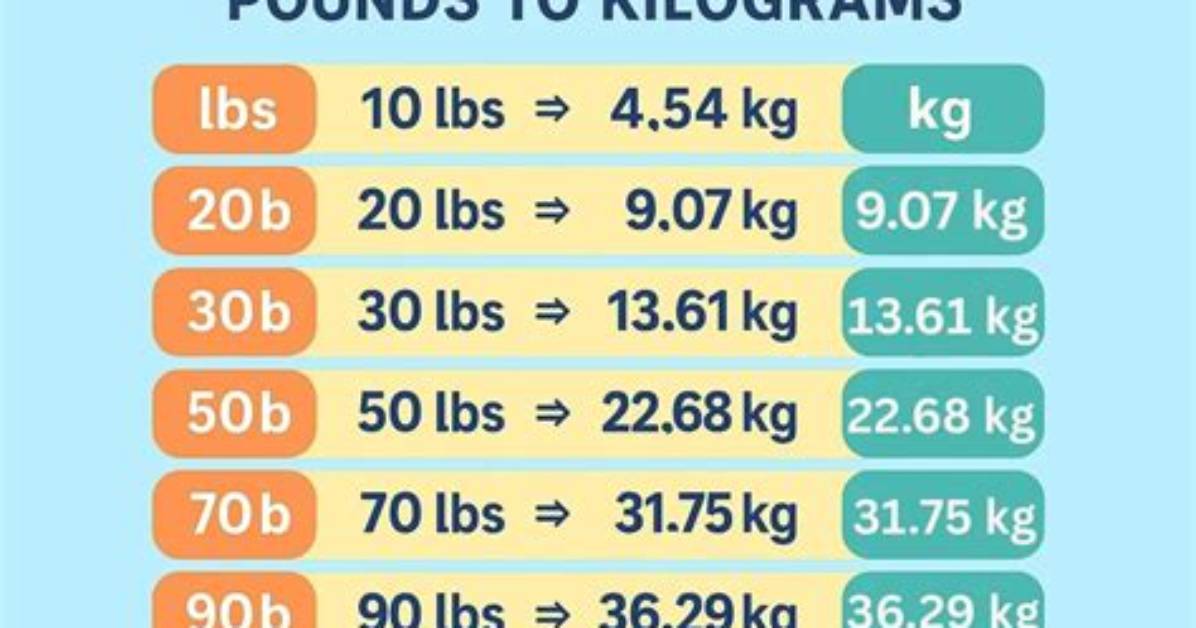
The arithmetic governing metric to imperial weight conversion rests on the international avoirdupois pound agreement of 1959. That treaty legally anchored one pound as exactly 0.45359237 kilograms. To convert 45 kilos to pounds, you divide 45 by that exact decimal constant, or multiply by its inverse, commonly shortened to 2.20462:
45 kg × 2.20462262185 = 99.2079 pounds
Under standard mathematical convention, this value rounds to 99.2 pounds at one decimal place and 99.21 pounds at two. Truncating the decimal entirely to claim that 45 kg is 99 pounds discards nearly a quarter-pound of physical mass. Rounding up to 100 pounds adds nearly eight-tenths of a pound.
Mass versus weight measurement creates an additional theoretical distinction. A kilogram is an absolute unit of mass, independent of local gravitational pull. The pound, in common commercial engineering, functions as a unit of force (pound-force) tied to standard Earth gravity of 9.80665 m/s². If you weigh a 45 kg calibration block in Denver versus Miami on a high-precision strain gauge scale, the gravitational discrepancy alters the reading by fractions of an ounce. Yet legal standards ignore this variance by anchoring the conversion strictly to mass.

