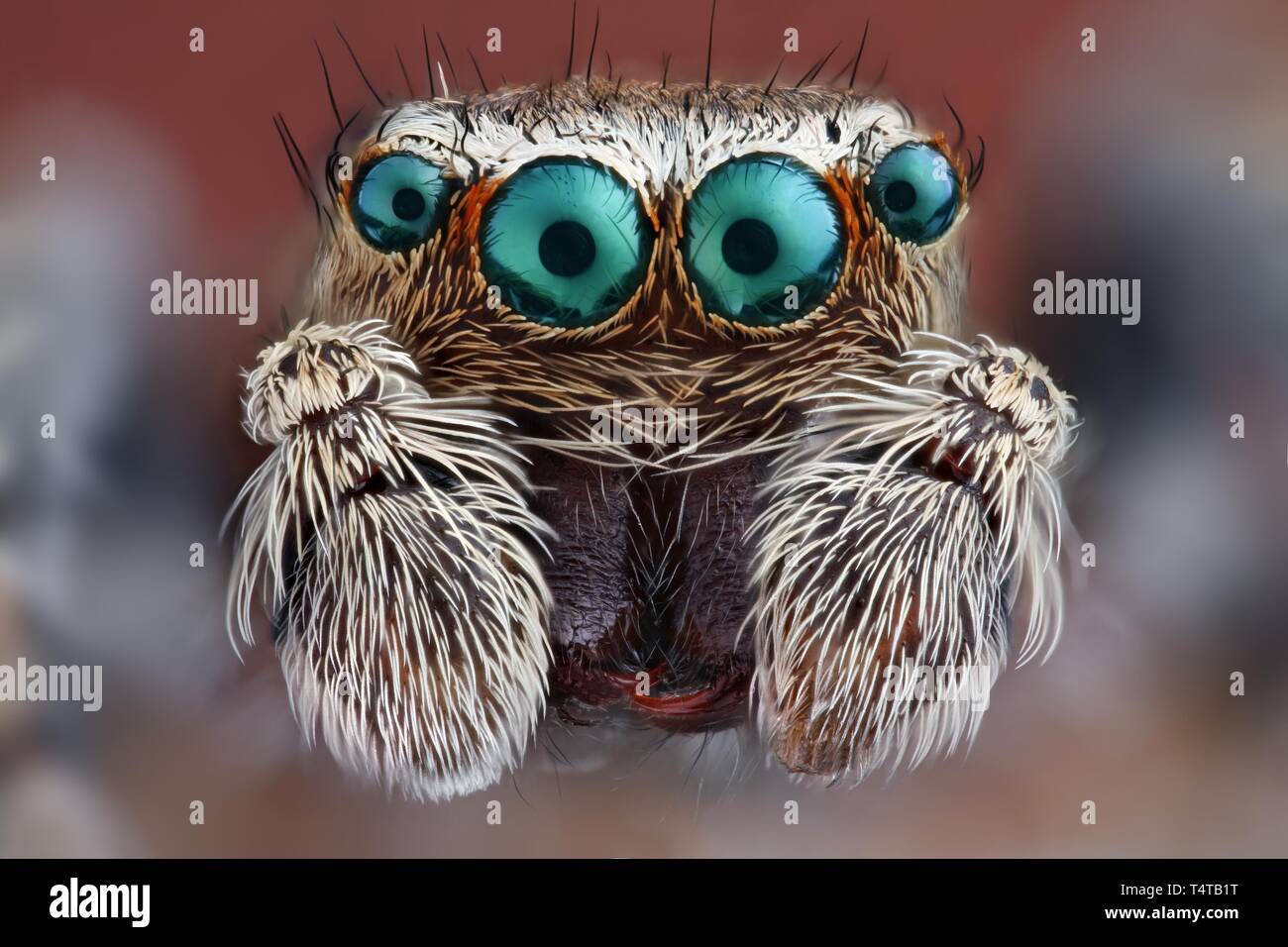
The arachnid visual apparatus typically features eight eyes divided into two functional tiers: principal eyes and secondary eyes. Understanding this anatomical split explains why different species react to humans in wildly contradictory ways.
Principal eyes, always the anteromedian pair, develop from distinct embryonic tissue and lack a tapetum lucidum (the reflective layer that makes cat eyes glow in headlights). In active day hunters, these lenses project inverted images onto multi-tiered retinas capable of processing polarized light and resolving fine details. Salticid vision boasts an angular resolution of roughly 0.04 to 0.1 degrees, remarkably sharp for an organism with a central nervous system containing fewer than 100,000 neurons.
Secondary eyes (anterolateral, posterolateral, and posteromedian) serve an entirely different tactical role. Equipped with reflective tapeta, these lateral lenses act as wide-angle peripheral motion detectors. They provide almost 360-degree surveillance with low spatial fidelity. The lateral eyes spot a blur of movement across the room, which triggers an immediate reflex: the spider pivots on its pedicel to align its high-definition principal eyes with the target.
Contrast this with web-weaving orbweavers (*Araneidae*) or cellar spiders (*Pholcidae*). In these nocturnal and web-bound families, the lenses are crude cuticular bulges. They can barely resolve shapes beyond basic light-dark circadian discrimination. For these spiders, the human eye does not exist as a distinct object. Their entire sensory world is mapped through slit sensilla on their exoskeletons and trichobothria (microscopic hairs) that measure sub-micron acoustic vibrations across web silk.

