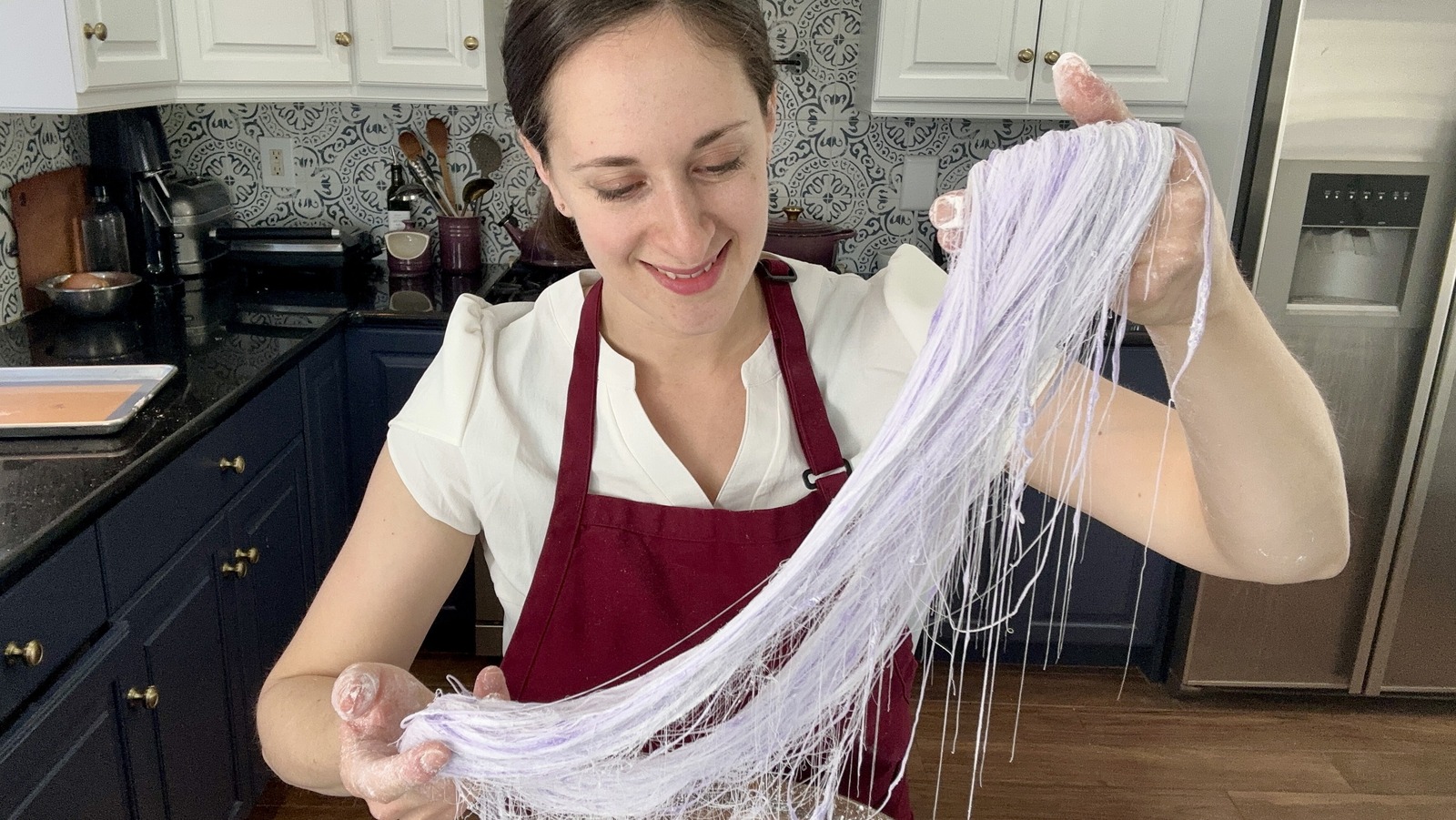
As the technique spread through East and Southeast Asia, it cross-pollinated with neighboring royal confectionery traditions. The most visible counterpart is Korea's kkul-tarae (Korean court cake). While modern Seoul vendors often market the dessert as a staple of the Joseon dynasty court, culinary historians note its contemporary boom originated in the late 20th century, directly borrowing the 14-fold mathematical technique from traditional Chinese confectionery.
The recipes differ in base syrups and internal fillings. Chinese dragon's beard uses a heavy foundation of golden maltose syrup, occasionally tempered with sugar and lemon juice, prioritizing a roasted peanut and sesame filling. Korean kkul-tarae swaps maltose for fermented honey and corn syrup, producing a slightly firmer, pearlescent strand wrapped around ground pine nuts, walnuts, and candied black beans.
In Malaysia and Singapore, street vendors adapted the recipe to humid equatorial heat, adjusting the boiling temperature of the syrup higher to yield a harder sugar matrix that resists moisture longer. These variations illustrate how a single core mechanical technique, hand-drawn sugar multiplication, serves different culinary palettes while preserving the essential theatrical draw of the live pull.

