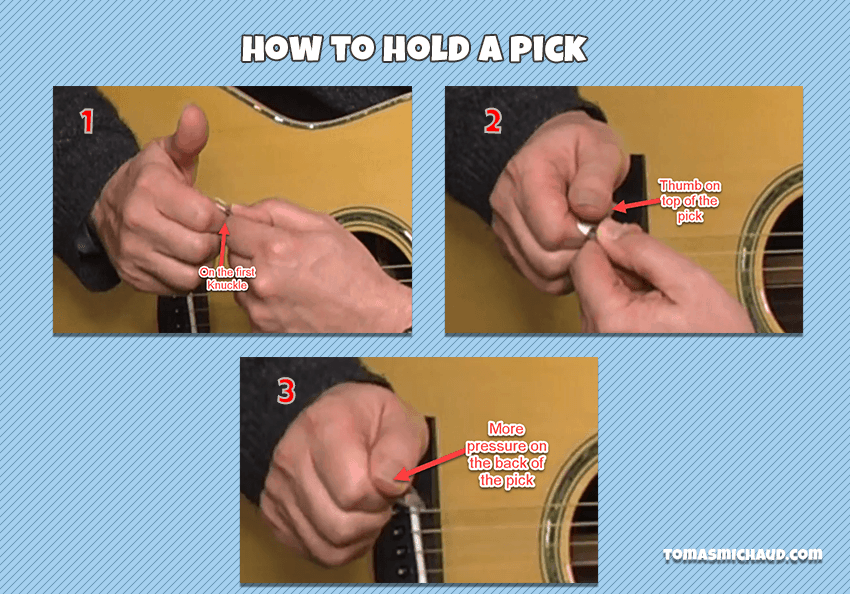
Striking a string with the pick completely parallel to the fretboard creates maximum surface friction. The flat face of the pick collides with the string, catches on the wound edge, and forces the picking hand to exert disproportionate force to pull through. The result is a harsh, percussive click, followed by string drag that completely derails precision lead playing.
High-efficiency players rely on two interconnected angular adjustments: edge picking and pick slant angle.
Edge picking refers to rotating the pick slightly along its long axis so that the edge, rather than the flat face, strikes the string. Angling the pick between 15 and 30 degrees relative to the string creates a beveled ramp. The pick slices across the wire, generating a smoother acoustic envelope, a fatter fundamental tone, and vastly reduced string drag.
Pick slanting, by contrast, refers to tilting the body of the pick relative to the guitar's top soundboard:
- Downward Pickslanting: The top edge of the pick tilts toward the player's chin, allowing upstrokes to escape clean into the air above the strings.
- Upward Pickslanting: The top edge tilts toward the floor, permitting downstrokes to clear the string plane effortlessly.
Integrating edge picking with controlled slanting transforms alternate picking technique from a choppy chore into a frictionless slicing motion. Fast players do not move their hands faster; they simply eliminate the physical obstacles that slow the pick down.
| Plectrum Gauge Range | Optimal Grip Tension | Mechanical Behavior | Target Musical Application |
|---|---|---|---|
| Thin (0.46, 0.60 mm) | Light (2/10) | Pronounced material flex; bright snap; built-in natural compression. | Acoustic strumming control, broad rhythm backing. |
| Medium (0.70, 0.88 mm) | Moderate (3, 4/10) | Balanced spring-back; moderate dynamic headroom; mid-range presence. | Versatile pop/rock rhythm, moderate lead passages. |
| Heavy (1.00, 1.20 mm) | Calibrated (4, 5/10) | Zero material flex; high string transfer; rich bottom end; immediate response. | Precision lead playing, hard-rock tracking, jazz single-note clarity. |
| Extra Heavy (1.50, 2.50 mm+) | Firm yet relaxed (4/10) | Absolute rigidity; requires edge picking to avoid string stalls; fat tone. | High-speed metal tracking, gypsy jazz, modern technical prog. |

