Before measuring a dime on a precision balance, you must check the date stamped on the obverse. A common source of confusion in workshop calibration stems from comparing pre-1965 silver pieces with post-1965 clad strikes.
Between 1946 and 1964, the US Mint produced Roosevelt dimes using a composition of 90% silver and 10% copper. These coins have an official mass of 2.500 grams, making them roughly 10% heavier than the dimes circulating today. When the price of silver surged in the early 1960s, the intrinsic melt value of standard dimes threatened to surpass their ten-cent face value, prompting the Coinage Act of 1965.
Every general-circulation dime minted from 1965 onward features a bonded "clad" sandwich: an inner core of 100% pure copper encased in two outer sheets composed of 75% copper and 25% nickel. Across the entire coin, the net alloy works out to 91.67% copper and 8.33% nickel. This cupronickel composition replicates the precise electrical conductivity and magnetic signature of traditional silver coins, ensuring that mid-century vending machines and modern transit fare turnstiles do not reject clad change.
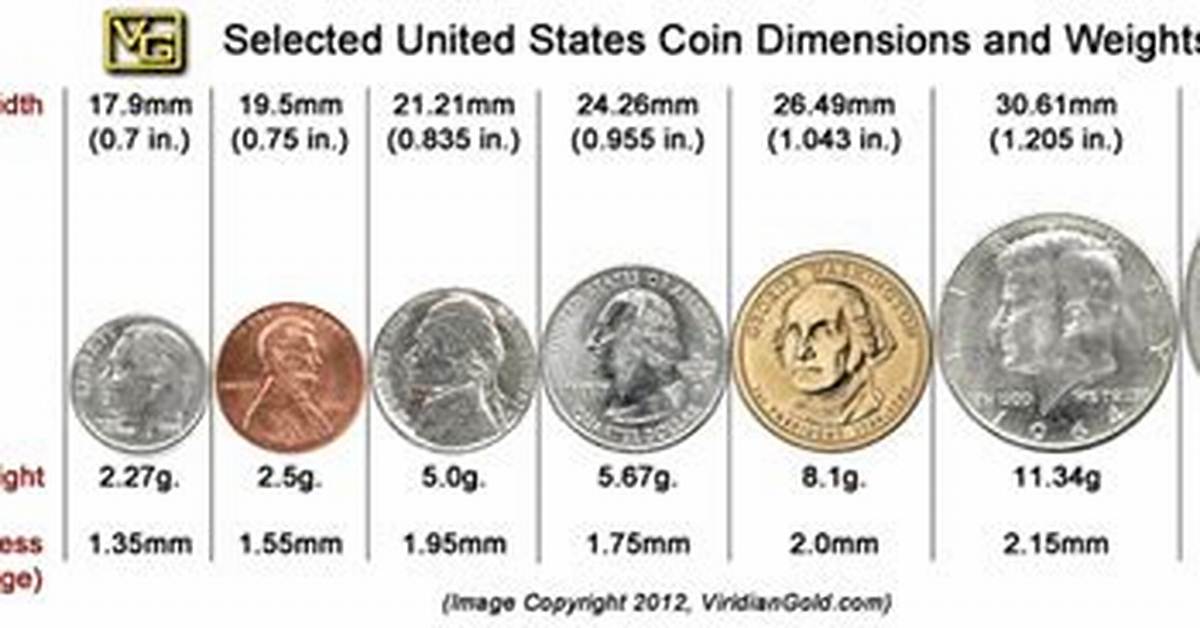
| Coin & Era | Diameter | Thickness | Weight | Edge Details |
|---|---|---|---|---|
| Roosevelt Dime (1965, Present) | 17.91 mm (0.705 in) | 1.35 mm (0.053 in) | 2.268 g (0.080 oz) | 118 reeds |
| Silver Dime (1946, 1964) | 17.91 mm (0.705 in) | 1.35 mm (0.053 in) | 2.500 g (0.088 oz) | 118 reeds |
| Lincoln Cent (1982, Present) | 19.05 mm (0.750 in) | 1.52 mm (0.060 in) | 2.500 g (0.088 oz) | Plain / Smooth |
| Jefferson Nickel (Modern) | 21.21 mm (0.835 in) | 1.95 mm (0.077 in) | 5.000 g (0.176 oz) | Plain / Smooth |
| Washington Quarter (Clad) | 24.26 mm (0.955 in) | 1.75 mm (0.069 in) | 5.670 g (0.200 oz) | 119 reeds |

