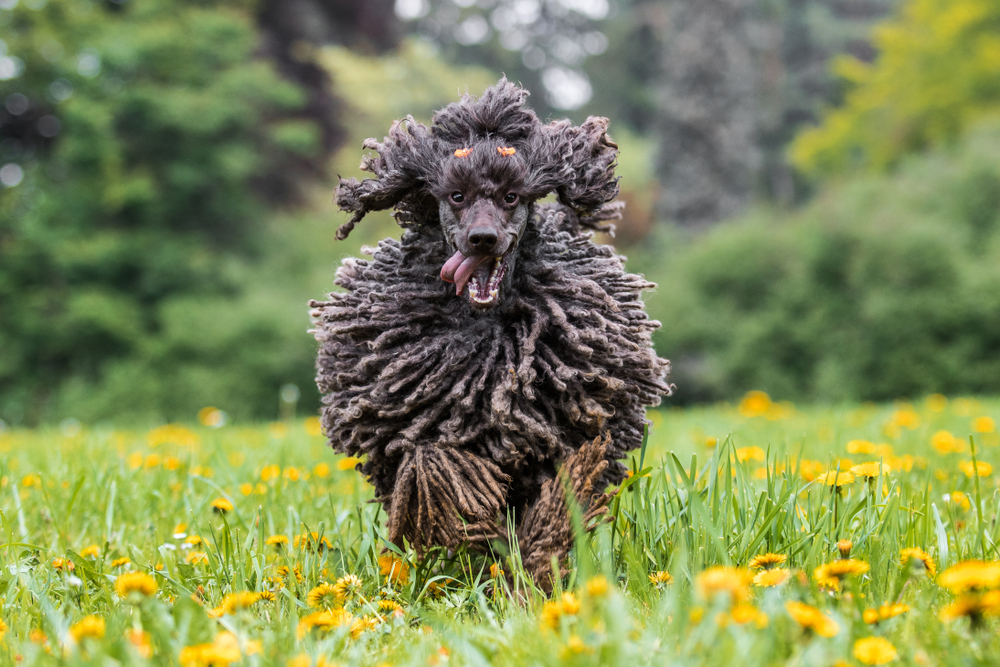
It is common to compare the corded standard poodle to Hungarian flock guardians and herders like the Komondor and Puli. However, the genetic mechanisms are sharply distinct, making standard poodle care far more demanding.
Komondors and Pulis are genetically wired to cord automatically. Their coats feature a deliberate ratio of coarse, long outer guard hairs to fine, curling undercoat fibers. Left completely alone, their fur naturally clusters into flat tassels or round cords with very little human assistance. Their skin produces specific lanolin profiles that help preserve the fiber without collapsing.
Poodles lack this effortless auto-cording trait. Because centuries of selective breeding focused on a dense, non-shedding, uniform coat suited for scissored water retrieve work, a poodle’s hair grows indefinitely without self-regulating boundaries. A Komondor coat stops growing at a functional length; a poodle’s coat will grow until it drags along the ground, picking up twigs, mud, and urine. The standard poodle breed standard allows for corded coats, but achieving that look requires human hands to emulate what natural sheepdog genetics accomplish instinctively.

