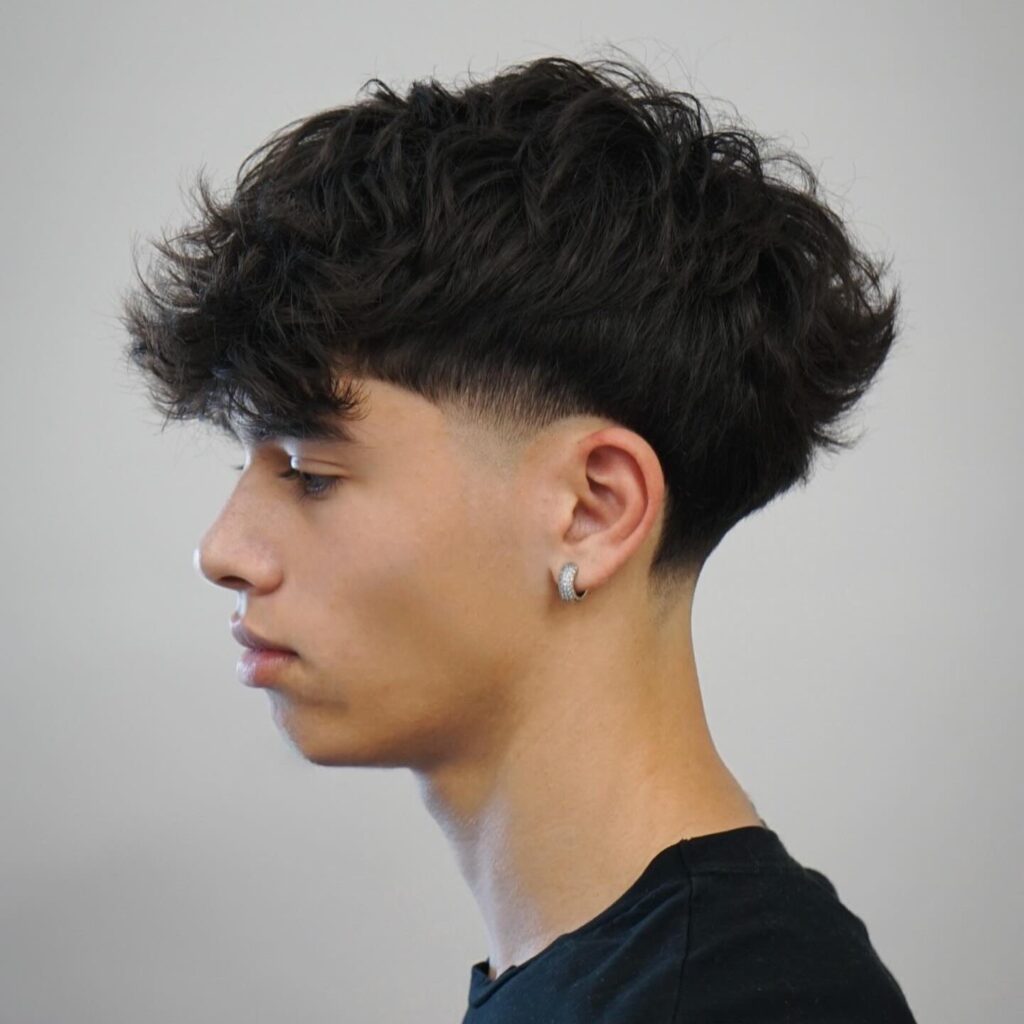
To understand why this silhouette dominates, one must examine its structural geometry. The traditional messy crop fade relied on a flat, horizontal perimeter cut bluntly across the forehead, often paired with high skin fades that exposed large swathes of the scalp. The blowout taper fade works in reverse. It preserves maximum density around the parietal ridge and temporal bones while leaving substantial length through the fringe.
The base requires precision clipper work: a low taper fade that cleans the sideburns down to the skin without climbing above the ear, paired with an equally meticulous tapered neckline. This keeps the perimeter immaculate while leaving the bulk of the sides intact. Barbers then blow out the sides and back with a round brush or hand tension, creating the signature rounded, outward-flared profile reminiscent of classic 1990s Italian tapers, modernized with contemporary street styling.
The focal point remains the textured fringe haircut resting on top. Instead of cutting in a straight line, barbers employ heavy point cutting, slide cutting, and channel carving. This internal removal creates pockets of air within the hair, allowing thick, heavy hair to lift upward and fall forward without collapsing under its own weight. It is an intentional balance of high-contrast tightness at the skin line and controlled chaos up top.

