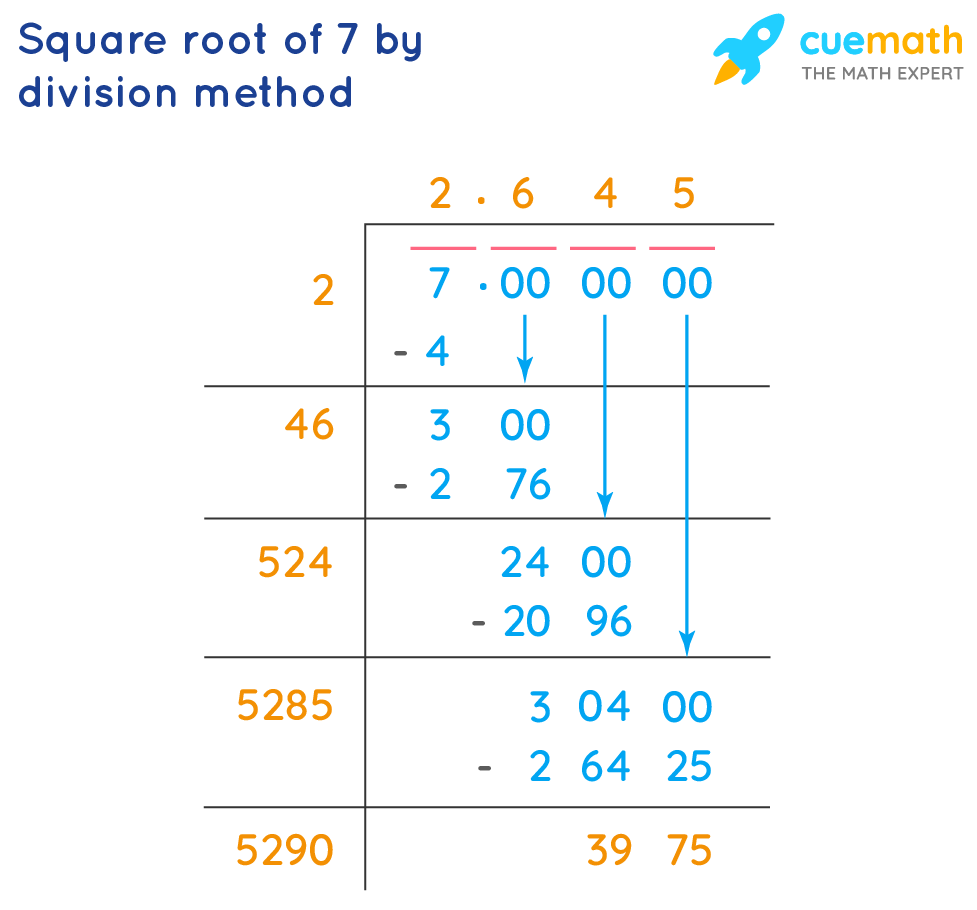
Q1: What is the exact value of root 7?
The exact mathematical value is written simply as $\sqrt{7}$. It cannot be written precisely in base-10 numerical digits because its decimal expansion runs infinitely without repeating.
Q2: Why is the square root of 7 considered a surd?
It is considered a surd because 7 is a whole number that is not a perfect square, meaning its root results in an irrational number that cannot be reduced further into integers or simple fractions.
Q3: How does IEEE 754 floating-point handle the square root of 7?
In computing systems using standard 64-bit double-precision floating-point format (IEEE 754), $\sqrt{7}$ is stored as a 53-bit significand. This gives roughly 15 to 17 significant decimal digits of precision, introducing tiny round-off errors in intensive scientific simulations.

