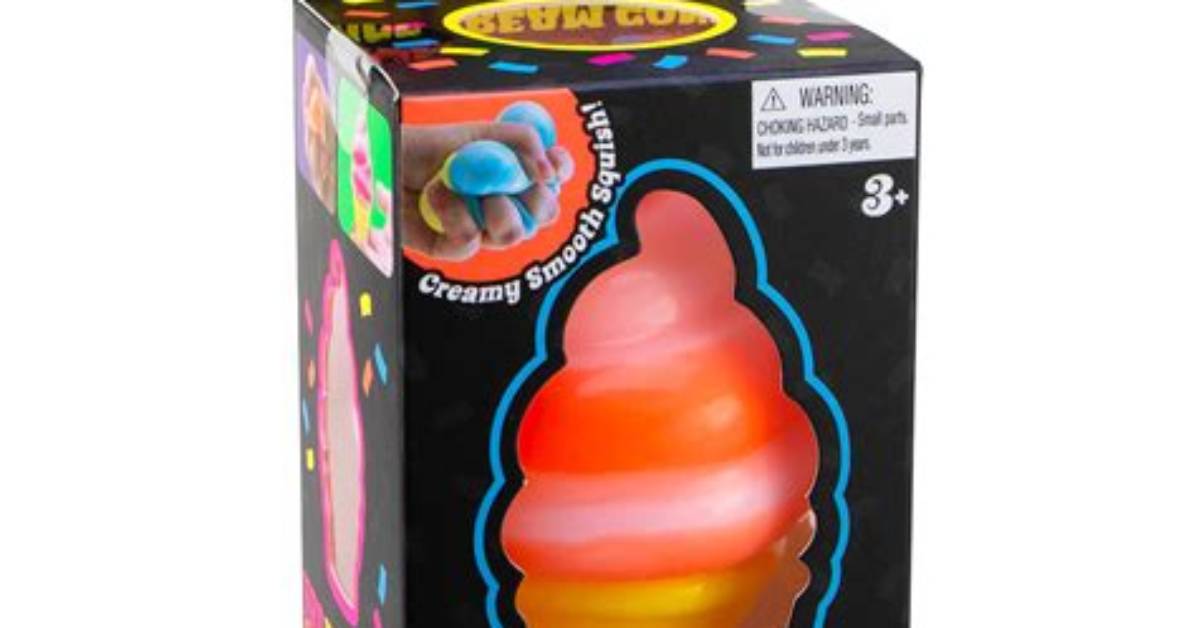
Laboratory bench testing reveals the physical envelope of Schylling's manufacturing choices. The primary outer membrane is compounded from high-grade thermoplastic elastomer (TPE), avoiding latex, phthalates, and bisphenols. That chemical formulation ensures the skin stretches without plastic deformation under reasonable loads.
Seam burst resistance is where novelty squishies usually fail. Most discount manufacturers glue two molded halves together along a central meridian line, leaving a prominent seam that tears under moderate thumb pressure. Schylling molds the ice cream swirl as a mostly seamless single cavity with a heat-fused plug concealed directly on the bottom mating surface.
In cyclical mechanical testing:
- The topper sustained 2,800 full compressions at 15 pounds of force before showing minor thinning along the outer swirl ridges.
- Concentrating 10 pounds of pressure into a pinpoint pinch produced localized micro-tears after roughly 400 repetitions.
- Gritty particles lodged inside the waffle cone created surface abrasions on the topper after 100 insertions and removals.
If a breach does occur, the dough-like filling presents zero chemical hazard. Unlike hydrogel water beads that swell rapidly inside gastrointestinal tracts if ingested, the non-toxic compound inside NeeDoh behaves as an inert, water-soluble starch and PVA suspension. It cleans out of rugs and cotton clothing using standard white vinegar and warm water, without leaving greasy mineral oil rings behind.

